📝 Topics Covered
- 1. First Principles
- 2. The Software Design & Architecture Stack
- 3. The Roadmap Stages
- 4. Low-Level Design (LLD) Video Resources
Have you ever wondered what it takes for some of the world’s most skilled developers to learn how to build systems inside high-scale organizations like Uber, YouTube, Facebook, or GitHub?
Even though you might know how to write code to make things work at least once, the bigger challenge is learning how to write code that makes software easy to change to meet evolving requirements.
If software cannot be changed easily, that makes it bad software, because it prevents us from satisfying the current needs of our users.
Anytime you face a complex problem, the best approach is to go back to First Principles.
1. First Principles
First principles thinking is the most effective way to break down complex problems.
- Deconstruction: It works by
deconstructinga problem all the way downto the atomic level—the fundamental truths where we cannot deconstruct any further. - Reconstruction: From there, we
reconstructa custom solution from the foundational parts we are absolutely sure are correct.
Since it is essential that software is designed to be changed, we must apply structured Software Design and Architecture principles at every layer of development.
2. The Software Design & Architecture Stack
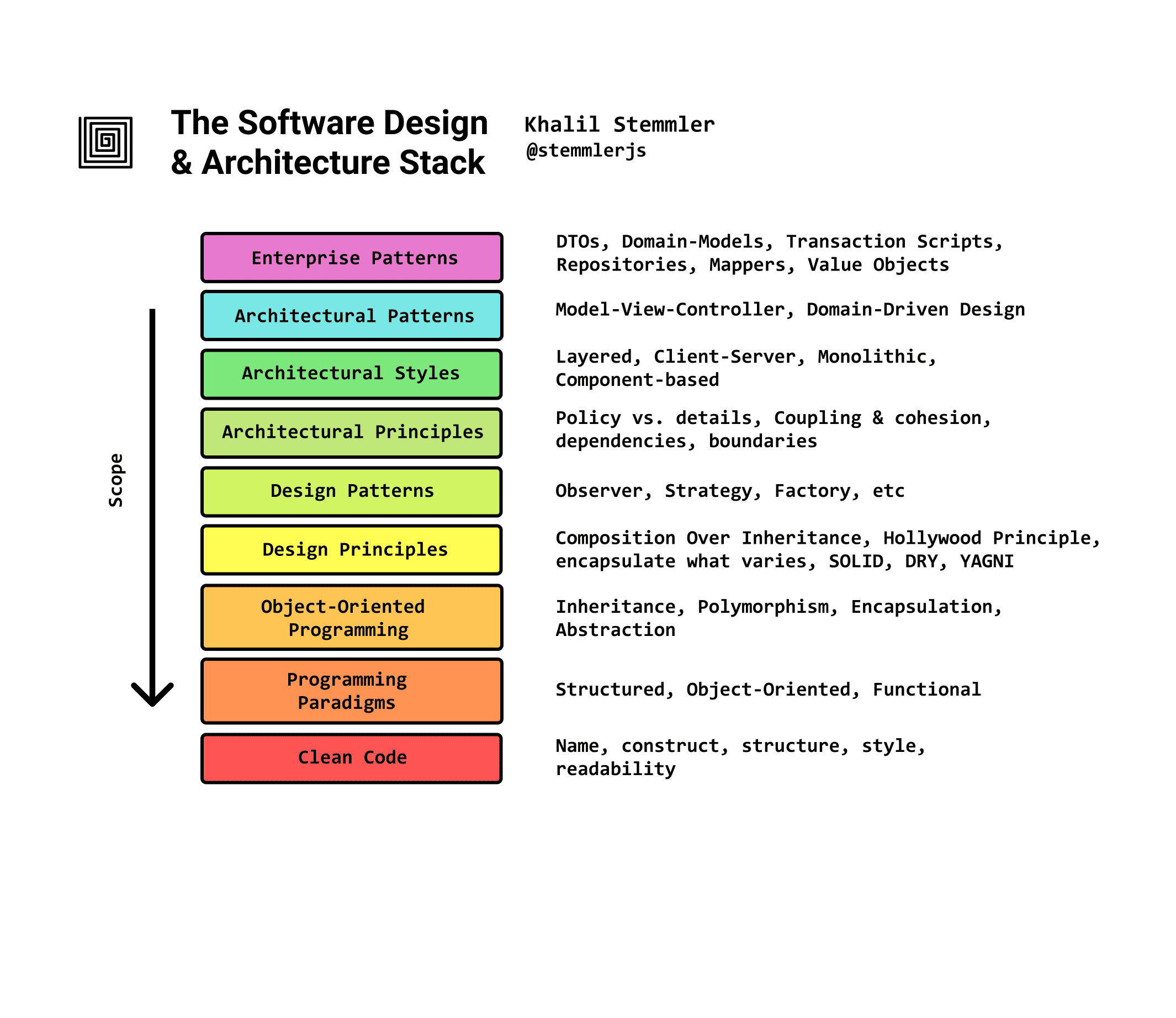
The software design and architecture stack shows all of the layers of software design, running from the most low-level coding details to the most high-level structural decisions.
The stack diagram below illustrates this path. Keep in mind that while each layer features key concepts, this serves as a structured roadmap rather than an exhaustive index.
3. The Roadmap Stages
Stage 1: Clean Code
The very first step toward creating long-lasting, robust software is mastering how to write clean code.
- Understandability: Clean code can be
understood easilyby everyone on the development team. - Readability & Maintenance: Clean code can be read, analyzed, and enhanced by a developer other than its original author.
- Core Characteristics: With understandability comes
readability,changeability,extensibility, andmaintainability.
Highly Recommended Learning Resources:
- Clean Code by Robert C. Martin
- Refactoring by Martin Fowler (2nd edition)
- The Pragmatic Programmer by Andy Hunt and Dave Thomas
- The Design of Everyday Things by Don Norman
Stage 2: Programming Paradigms
It is essential to understand the three major programming paradigms and how they influence the way we organize our code.
- Object-Oriented Programming (OOP): The tool best suited for defining how we
cross architectural boundariesusing polymorphism and plugins. - Functional Programming: The tool we use to
push data and side-effects to the boundariesof our applications. - Structured Programming: The tool we use to
write sequential algorithmsand control flow.
Effective software uses a hybrid of all 3 programming paradigms at different times. Understanding where each excels will dramatically improve the quality of your overall designs.
Stage 3: Object-Oriented Programming
Object-Oriented Programming (OOP) enables us to build a robust plugin architecture and introduce maximum flexibility into our projects. OOP leverages 4 core principles that help us model rich enterprise domains:
- Encapsulation:
Grouping state and behaviortogether while hiding internal details. - Abstraction:
Hiding complexityby exposing only essential features through interfaces. - Inheritance:
Reusing and extendingexisting code structures. - Polymorphism:
Dynamic dispatchingof behavior, allowing a single interface to represent multiple underlying forms.
Stage 4: Design Principles
While OOP is powerful, it can introduce serious design challenges if misapplied:
- When should I use composition instead of inheritance?
- When should I use an interface versus an abstract class?
Design principles act as highly established, battle-tested object-oriented best practices that serve as crucial guide-rails for clean coding:
- SOLID Principles: The industry standard for robust design, particularly the Single Responsibility Principle (SRP).
- The Hollywood Principle: “Don’t call us, we’ll call you” (inversion of control).
- DRY (Don’t Repeat Yourself): Eliminating redundant logic representations.
- YAGNI (You Aren’t Gonna Need It): Avoiding over-engineering and premature optimization.
Stage 5: Design Patterns
A design pattern is a structured walkthrough of a well-tested approach used to solve a generally occurring, recurring problem in object-oriented software design.
There are 3 major categories of design patterns:
- Creational: Managing
object creation mechanismsto make systems independent of how their objects are created (e.g., Singleton, Factory, Builder). - Structural: Simplifying design by identifying a simple way to
realize relationships between entities(e.g., Adapter, Decorator, Facade). - Behavioral: Identifying common
communication patterns between objectsand realizing these patterns (e.g., Strategy, Observer, Command).
Stage 6: Architectural Principles
Architectural principles teach us how to manage relationships between components, express high-level policy, and cleanly identify architectural boundaries:
- Policy vs. Details: Keeping high-level business rules independent of low-level implementation details (like databases or web frameworks).
- Coupling & Cohesion: Minimizing dependencies between modules while ensuring elements inside a module belong together.
- Component Principles: Understanding how components are released, combined, and structured into larger deployment units.
- Boundaries: Establishing physical and logical lines of separation to isolate core application code.
Stage 7: Architectural Styles
Architectural styles represent different high-level approaches to organizing our code into large modules and defining how they communicate:
- Structural Styles:
- Monolithic: Core logic packaged into a single, cohesive unit.
- Layered Architecture: Organizing modules into hierarchical tiers (e.g., Presentation, Application, Domain, Infrastructure).
- Messaging Styles:
- Event-Driven: Systems reacting to state changes via asynchronous events.
- Publish-Subscribe: Decoupling message producers from consumers using middleware message brokers.
- Distributed Styles:
- Client-Server: Centralized servers serving multiple remote clients.
- Peer-to-Peer: Decentralized communication where nodes share equal privileges and responsibilities.
Stage 8: Architectural Patterns
Architectural patterns represent operational patterns that implement one or more architectural styles to solve concrete, system-wide problems:
- Domain-Driven Design (DDD): Designing systems based on rich, real-world business models.
- Microservices: Breaking an application into small, independently deployable services.
- Serverless: Outsourcing infrastructure management to cloud providers, scaling on demand.
- Model-View-Controller (MVC): Decoupling data representation, user interface, and business control logic.
Stage 9: Enterprise Patterns
Enterprise patterns represent design patterns tailored specifically to coordinate complex corporate transactions, database queries, and high-volume data integrations:
- Data Transfer Objects (DTOs):
Efficiently carrying dataacross network and architectural boundaries. - Object-Relational Mapping (ORMs):
Bridging the gapbetween object structures in code and relational tables in databases. - Domain Models: Consolidating behavior and data into rich, testable objects.
4. Low-Level Design (LLD) Video Resources
Here is a collection of beginner-friendly guides and high-quality resources to kickstart your Low-Level Design journey:
- Classic Research Papers:
- Curated Roadmaps & GitHub Archives:
🎥 Recommended Watch Guides
How to Learn LLD as a Beginner
What to Study for Low-Level System Design Interviews